

Ireland’s university LLM landscape:
cautious adoption and three visible outliers
The latest report to be issued in the Global Higher Education LLM Landscape series covers the Republic of Ireland. This blog posting is a summary of and reflections on key points in the report.
The report suggests a sector still moving carefully on Large Language Models:
- Three universities stand out from the 17 funded higher education institutions: Dublin City University, University College Dublin and the University of Galway – but the report includes a short description of the state of AI at each of the other 14 institutions
- Google is stronger than in some other countries
- Microsoft Copilot Chat is mostly a baseline rather than a strategy
- Language and governance issues make the Irish pattern distinctive.
Summary
This report on the Republic of Ireland is likely to be one of the more interesting in the current series on LLMs in high-performing economies because it does not fit the pattern familiar from the United States. In Ireland, the picture is earlier stage and more uneven. There is clear activity, but much of it is still at policy level (though with policies at every institution; a useful baseline); there is widespread access to baseline tools, but very little premium procurement; and the institutions with the strongest visible adoption are not all taking the same route.
Three universities are ahead of the pack – but in different ways
Starting with the institutions showing clear evidenceable signs of substantive adoption, only three universities stand out.
Dublin City University is the strongest all-round example: its AI Hub lists Google Gemini, NotebookLM, Microsoft Copilot Chat, and Zoom AI Companion as available to staff and students.
University College Dublin is also clearly advanced, but in a more selective way: it confirms Gemini, NotebookLM, and Zoom AI Companion for employees, while explicitly deciding not to offer Microsoft Copilot.
University of Galway represents a third model again. It is the only Irish university with a confirmed premium LLM arrangement, but that arrangement is not a campus-wide licence: it is a staff opt-in Microsoft 365 Copilot Premium offer.
In other words, the leading edge exists, but it is small and strategically diverse. (Thus very unlike the way the Canvas LLM roared into the US R1 level a few years ago,)
The wider picture is a cautious and policy-heavy sector
The first striking feature is the Google story. Unlike countries where Microsoft has become the default frame for higher education AI, Irish universities show a stronger Google Workspace for Education footprint. DCU and UCD have both formalised Gemini and NotebookLM access, and UCD has gone further by making clear that Microsoft Copilot is not available there. That matters because it suggests that in Ireland the Google-Microsoft balance is more open than, say, in the UK, and that Google’s education agreements are a major route by which AI tools are entering institutions.
At the same time, Microsoft remains present almost everywhere, but through a much lower-level route. Fourteen of the 17 institutions have Microsoft Copilot Chat as their baseline AI offer under standard Microsoft 365 entitlements. That is important, but it should not be overstated. In most cases this is not evidence of a distinctive institutional AI strategy; it is simply the bundled floor now available through an existing nearly-ubiquitous productivity platform.
This is why the University of Galway case is so notable. Its staff opt-in Microsoft 365 Copilot Premium model is the only confirmed premium LLM arrangement found in the Irish higher education sector. Yet even here the provision stops short of a full institutional rollout.
What is missing is also revealing. No Irish university in this survey has a confirmed ChatGPT Edu agreement. None has a confirmed Claude for Education agreement either. It would be unwise to assume that this will remain so for long, especially as these markets move quickly, but as of early May 2026 the absence reinforces the impression of a sector proceeding carefully rather than rushing into branded premium deals.
Yet universities in the Republic of Ireland seem better funded than in some nearby countries, the Technological Universities have had access to substantial project funds over the last few years, and the HE sector also has access to Erasmus+ funding, which could have been used for AI pilot projects or departmental roll-outs.
Procurement complexity may be part of the explanation. Ireland still lacks a university-specific national AI procurement route, and no published Office of Government Procurement AI framework had appeared by the report date.
The Technological University subsector underlines this point. The six technological universities and institutes covered here are uniformly still at the policy stage: they all have academic integrity policies, generative AI guidance, or both. That is a useful place to be in. However, none of them have confirmed premium LLM agreements. That may reflect budget constraints, vocational priorities, and the relative newness of several of these institutions in their current form.
The specialist colleges are also cautious, but in institutionally distinctive ways. NCAD was the earliest in the survey to publish a formal generative AI policy. RCSI has the most recent policy launch and gives the issue a strongly healthcare-oriented framing. Mary Immaculate College is notable for its STEAM AI incubator, which points to research-level experimentation with frontier tools even without a campus-wide licence.
Two structural factors help explain why the Irish pattern looks different:
- The first is the Irish language. The Higher Education Authority’s framework explicitly tells institutions to evaluate AI systems for their performance in Irish. Research reports have underlined how much weaker mainstream LLM performance still is in Irish Gaelic than in English. That creates a real equity issue for Irish-medium provision and for universities with Gaeltacht links, even if research is under way to close these gaps.
- The second factor is governance. Ireland’s role as the EU data protection hub for many major US technology firms appears to have raised institutional sensitivity to privacy and compliance issues. UCD’s document on governance principles for AI adoption is the clearest example of how demanding that governance stance can become in practice.
Conclusion
Overall, the Republic of Ireland does not yet show the kind of broad premium LLM procurement now visible in the US, nor does it have country-wide agreements of OpenAI’s Education for Countries model (as, in Europe, Estonia and Italy have).
Instead, it shows a more selective and policy-conscious pattern: strong Google-enabled adoption at a small number of universities, widespread but low-level Copilot Chat availability, an as-yet empty field for OpenAI, Anthropic, and Manus, and a set of national conditions – especially around language and governance – that make Irish adoption distinctive.
For the next run of the survey (expected in the autumn), the key things to watch will be any Office of Government Procurement AI framework, any ChatGPT Edu or Claude for Education announcements, any move beyond the free Google entitlement, and any practical advances in Irish-language AI tooling that might affect university procurement.
For now, Ireland looks less like a late adopter than a careful adopter.
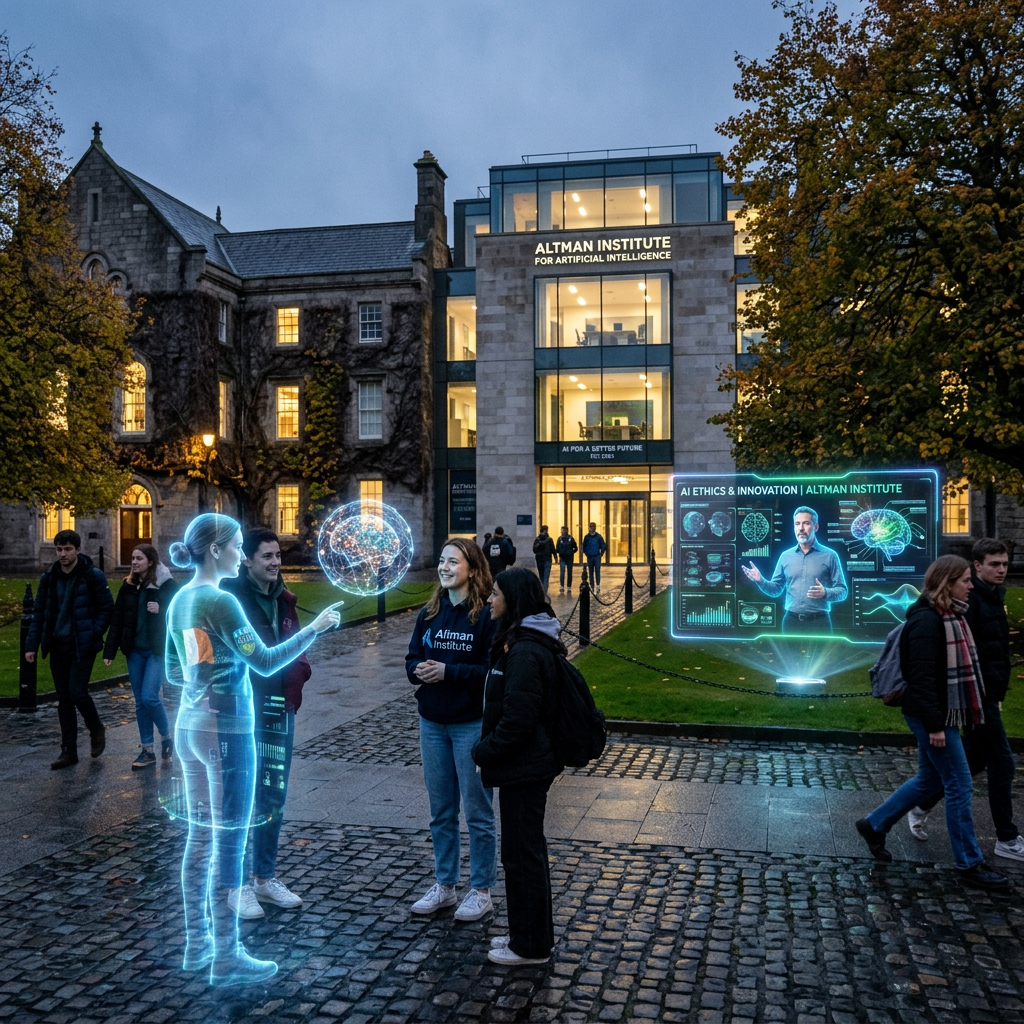
It may be a while before AI in Ireland’s universities reaches the level in the image below.
Reflections
Things move fast in LLM-report-land. Three weeks ago when the Ireland report was being planned the initial plan was to focus only on the institutions in the Irish Universities Association. On reflection, and having considered my own experience as a consultant to institutions in the Republic, I decided to include all the Technological Universities in the report. Then the LLM reviewer (Claude Opus in this case – very fussy) observed that I had missed out three specialist institutions: thus for the final pass all teaching institutions funded by the Higher Education Authority were included. And the report is all the better for that. A feature that we cannot commit to repeat in reports for larger countries like UK, US or Canada is that it contains a narrative entry on the state of AI in each of the 17 institutions, with references.
This is the first work-related report I have prepared where searching in multiple languages is fundamental to getting a rounded view of the national situation. Since this feature will be required in most of the subsequent reports (Netherlands then Sweden are next, after UK will drop tomorrow), I would particularly welcome feedback on language aspects and the role of the Gaeltacht in particular.

