Understanding Fable’s Hallucination Mitigation Techniques

A painterly landscape shows Saint Elmo standing in a wooden boat on a misty lake at twilight. A soft blue electrical glow clings to the mast, bow, and rudder. In the distance, a sunlit mountain rises beyond mist, rocky islets, and a waterfall, while pale will‑o’-the‑wisps hover over marshland to one side.

On June 10, 2026, a dialogue with Fable, Anthropic's new LLM, addressed its ability to minimize hallucinations in citations. While improvements in verification processes were noted, Fable emphasized the necessity of rigorous URL verification practices. Various levels of hallucination were discussed, leading to an architecture that combines automated and manual verification for accurate citation management.

Fable breaches a major bastion against Word automation

Ancient soldiers attacking a stone fortress with archers and commanders on horses near observant philosophers

My recent interaction with Anthropic's new Mythos-class LLM, Fable, revealed its capability to effectively deploy Microsoft Source Manager for reference management, overcoming a significant challenge that previously hindered other LLMs in their automation of Word. Fable's unique approach demonstrated an end-to-end integrated solution, marking a significant advancement in LLM functionality and workflow hyper-efficiency.

Global Higher Education LLM Landscape: Anthropic’s Claude for Education

A luminous fantasy-art AI figure representing Claude sits in meditation above the Earth, with glowing network arcs linking key global market points amid crystals, planets and a deep cosmic background.

Anthropic launched Claude for Education in April 2025. Despite early adoption by five U.S. universities and some activity in the UK and a few other countries (e.g. AU, NL), global HE traction seems limited, with more focus on coding and non-HE educational sectors. National agreements, so far only with Rwanda and India, tend to emphasize sschools or research collaboration over higher education.

Higher Education LLM Landscape: Republic of Ireland

Four university students and an academic work together on a sunlit Georgian college lawn in Ireland, using laptops and tablets that show AI interfaces: one displays a bilingual Irish and English research pane. Behind them, green Irish fields divided by drystone walls lead towards the modern Silicon Docklands skyline under a wide pale-blue sky

The report on Ireland's universities and their adoption of Large Language Models (LLMs) reveals a cautious approach, with three standout institutions: Dublin City University, University College Dublin, and University of Galway, each employing different strategies.

Global Higher Education Landscape: LLM report for academic domains – Manus

This report analyzes Manus, an autonomous AI agent launched in March 2025 by Butterfly Effect. Despite interest from institutions, searches reveal no campus-wide deployments, yet it has a strong focus on students. Its turbulent ownership remains unresolved at the time the research was concluded (late April 2026).

Global Higher Education Landscape: LLM report for academic domains – OpenAI’s ChatGPT

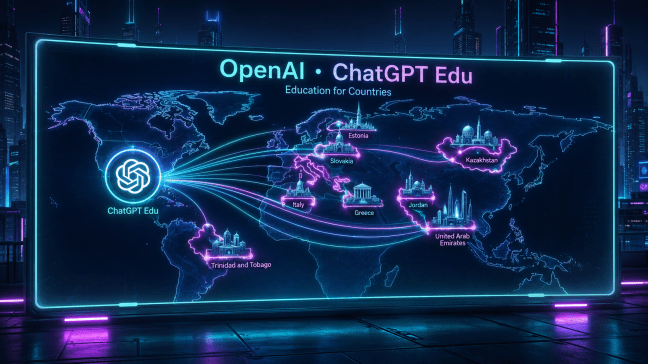
This report introduces a series on the deployment of institution-wide LLM agreements in higher education across OECD, EU and similar high-performing economies. It highlights the global adoption of OpenAI's ChatGPT Edu, noting significant national agreements in countries like Italy and Estonia, while emphasizing decentralized U.S. adoption at major universities. Future reports will cover additional countries and LLM SaaS systems.

Robot World’s Hidden Prize: How Robot Fleets Could Improve AI

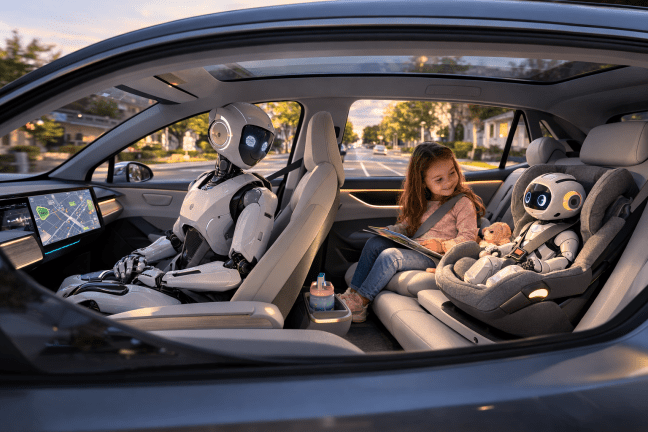
Self-driving car with adult-size robot in front not driving, and child plus child-size robot in back - and an analogue teddy!

The next big bottleneck in AI may not be model size or compute. It may be access to grounded, real-world experience. If millions of embodied robots begin operating in homes, vehicles and care settings, they could generate filtered experience traces that improve LLM-plus systems far beyond what internet text alone can provide. Child-size companion robots may be especially important because they open access to a domain that today’s AI models understand badly: children’s language-in-context and everyday micro-social interaction. But this only works if the architecture is privacy-first: central systems should receive distilled updates, not intimate raw detail from children’s lives, except under tightly governed emergency rules.

Reflections on the closure of the OER Foundation and the implications for OER policies worldwide

The recent announcement of the impending closure of the OER Foundation (based in Otago in New Zealand) has drawn attention again to the sustainability (or not) of major OER initiatives and the longevity of OER policies. Acting on this we decided to do one of our rapid AI-assisted reviews of the current state of the OER domain. The results were challenging. For speed, this review initially started with a series of seven questions put to ChatGPT (version 5.2) - which we have used a lot over the last three years for policy anal