Towards the one-click thesis: a report on the Strait of Hormuz

NASA satellite image of Strait of Hormuz north of UAE and Oman

This 62-page document with 160 references discusses the geopolitical tensions surrounding the Strait of Hormuz, including Iran's closure impacting global energy flows. It analyzes military and diplomatic strategies for reopening the Strait, assesses coalition capabilities, and outlines challenges and potential solutions. The report is informed by multi-lingual sources, integrating diverse regional perspectives. Unusally it was generated by a team of AIs, with minimal direction from, a human. It is the first thesis-length demonstrator in a series of studies on the actual power of LLMs to write well-researched well-argued documents.


Robot World’s Hidden Prize: How Robot Fleets Could Improve AI

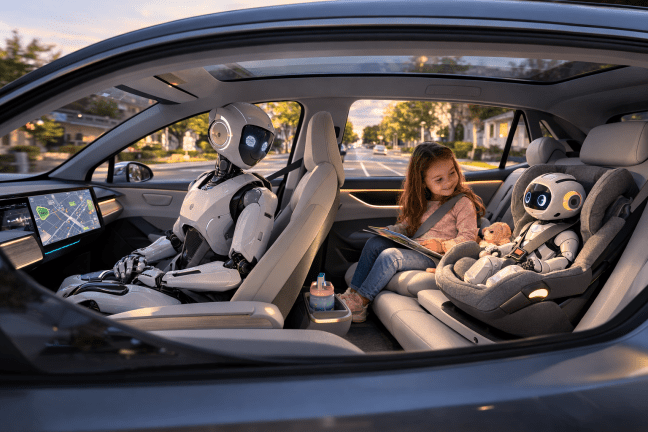
Self-driving car with adult-size robot in front not driving, and child plus child-size robot in back - and an analogue teddy!

The next big bottleneck in AI may not be model size or compute. It may be access to grounded, real-world experience. If millions of embodied robots begin operating in homes, vehicles and care settings, they could generate filtered experience traces that improve LLM-plus systems far beyond what internet text alone can provide. Child-size companion robots may be especially important because they open access to a domain that today’s AI models understand badly: children’s language-in-context and everyday micro-social interaction. But this only works if the architecture is privacy-first: central systems should receive distilled updates, not intimate raw detail from children’s lives, except under tightly governed emergency rules.