

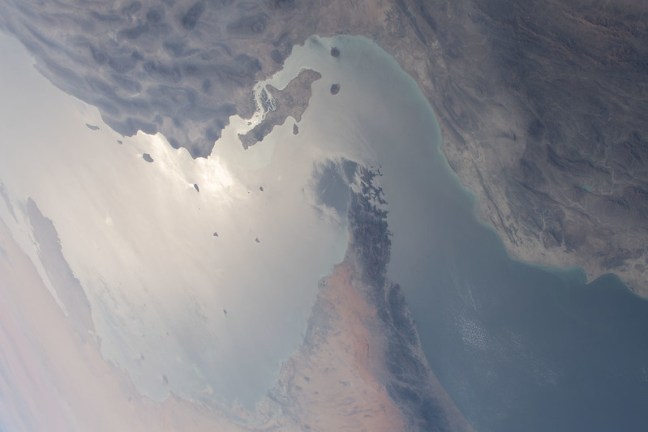
This 62-page 16,000-word document, Securing the Strait of Hormuz, summarised below, with over 160 references, has been produced largely by LLMs. It covers the controversial issues around the possible re-opening of the Strait of Hormuz, with many references from local publications in Arabic, Hebrew and Farsi. To us it is a major step in the direction of automation of long reports.
Disclaimer
I am not the author, merely the jockey on the horse.
The domain of Gulf Politics is a long-standing interest of mine. But it not my core expertise, indeed it is well beyond the sphere of my professional authority as a specialist in online learning including open educational resources and artificial intelligence.
Consequently I do not offer any warranty as to the conclusions of this document – I am not the lead author, merely a small contributor. A few topics on what I felt should be covered are my direct input but the document structuring and expression are almost completely the work of the LLMs involved.
Whatever you think of the report and LLMs, there is a great deal of unarguable factual information in the report which others may wish to draw on. Readers are welcome to fact check, plagiarise check or perform other tests to prove beyond reasonable doubt that it was written by AI and that (probably) they don’t like it. The report is OER.
Usefully for me Copilot regards the document as having “Low plagiarism risk, High original synthesis, and Appropriate academic/analytic citation discipline.” Are congratulations for that down to Manus or to me?
The production workflow uses the markdown-first (Word second) approach best suited to generate large complex documents requiring multiple merges and updates. There will be more detailed information on the workflow in due course. It is being used for other long reports in preparation including those for Robot World.
Earlier documents in this 1-click thesis series such as Greenland, the High North and Collective Defence and Analysis of the OER Landscape: A Call for Strategic Re-evaluation took a Word-first approach but this is not robust enough for the multiple merges and updates required for authoritative fact-checked long structured reports.)
Securing the Strait of Hormuz: A Politico-Military Assessment
Executive Summary
The closure of the Strait of Hormuz by Iran’s Islamic Revolutionary Guard Corps, triggered by the US–Israeli Operation Epic Fury on 28 February 2026, represents the most severe disruption to global energy flows since the 1973 oil embargo. Approximately 20 million barrels of oil and 20 per cent of global liquefied natural gas exports normally transit the Strait daily. The closure has driven Brent crude above $100 per barrel, doubled European gas prices, and generated cascading effects on food prices, fertiliser supplies, and industrial output worldwide. [M1]
This assessment examines how a coalition of NATO members and Arab Gulf states could restore safe passage through the Strait, even under the assumption that Iran refuses to surrender after its drone and missile stocks are substantially depleted. It integrates military analysis with diplomatic options, legal frameworks, alternative energy routes, and regional perspectives drawn from Arabic, Hebrew, Turkish, and Farsi sources alongside Western reporting.
The Threat. Iran’s anti-access strategy relies on five overlapping layers: anti-ship missiles (including ballistic variants with manoeuvring warheads), approximately 3,000 swarm craft, one-way attack drones, a stockpile of 5,000–6,000 naval mines, and midget submarines. Three fortified islands – Abu Musa, Greater Tunb, and Lesser Tunb – command the shipping lanes. Iran is not enforcing a total closure but a discriminatory-access regime, permitting passage to vessels from “non-hostile” states while denying it to those associated with the United States and Israel. [M44] [M60] [M61] [M62]
The Coalition. The practical coalition for Hormuz operations consists of the United States and France, with limited British air support (four Typhoons and one destroyer), a 22-state broader coalition of varying commitment, and Gulf states providing basing, air defence, and surface combatants. Italy has withdrawn. The United Kingdom’s deployable naval strength is at its lowest in history. Saudi and UAE forces are stretched across Yemen, Sudan, and homeland defence against sustained Iranian drone and missile attacks. [M74] [M75] [M76] [M57]
The Campaign. Reopening the Strait requires a phased, multi-domain operation: suppression of coastal and island-based anti-ship systems; seizure of the three contested islands; mine countermeasures; convoy escort operations; and persistent counter-drone and counter-swarm patrols. A prerequisite – not yet addressed – is neutralising the Houthi threat to Red Sea bypass routes, without which even the primary alternative (the Saudi East-West pipeline to Yanbu) remains at risk.
The Depletion Crisis. The central operational problem is not Iranian strength but coalition sustainability. Defending against Iranian drones and missiles is consuming interceptors at an unsustainable rate: a single Patriot interceptor costs $4–6 million to destroy a $35,000 Shahed drone. The UAE used 803 Patriot missiles on the first day alone. Global Patriot production is approximately 60–65 missiles per month. The cost-exchange ratio of 114:1 in Iran’s favour means the coalition is losing the war of attrition even while winning every engagement. [M102]
The Ukrainian Solution. Ukrainian drone technology – battle-tested against 57,000+ Shahed attacks – is the most cost-effective force multiplier available. A package of 100–150 Magura naval drones, 3,000–5,000 interceptor drones, expanded advisory teams, and electronic warfare systems would cost $85–165 million – less than the price of two SM-6 interceptor missiles at current production rates. Some 228 Ukrainian specialists are already advising Gulf states. The principal obstacle to scaling this up is political: the Trump administration’s reluctance to be seen as dependent on Ukraine. [M6] [M13]
Alternative Routes. Existing bypass infrastructure (primarily the Saudi Petroline to Yanbu and the UAE Habshan–Fujairah pipeline) can handle approximately 6.5 million b/d – roughly one-third of normal Hormuz flows. Qatar’s 80 million tonnes per year of LNG has no bypass option whatsoever. Under a “Watchful Peace” scenario lasting a decade or more, a crash programme of pipeline duplication costing $29–46 billion could close the crude oil gap within 5–7 years. Canal routes are impractical. [R1] [R4] [R6]
Diplomacy. The Trump administration has transmitted a 15-point ceasefire plan to Iran via Pakistan, demanding nuclear dismantlement, proxy disarmament, and Strait reopening in exchange for sanctions relief. Iran has rejected it and issued counter-demands including Gulf base closures, reparations, and a Hormuz transit fee modelled on the Suez Canal. Selective reopening of the Strait to “non-hostile” vessels may represent the beginning of a face-saving de-escalation – or a trap. The island sovereignty dispute (Abu Musa, Greater and Lesser Tunb) is the most productive diplomatic lever: international models such as the Åland Islands and Svalbard offer frameworks for demilitarisation, shared access, and deferred sovereignty. [D11] [D16] [L17] [L18]
Legal Framework. Iran’s closure of the Strait is illegal under both UNCLOS transit passage provisions and customary international law. Coalition escort operations have a firm legal basis. Environmental escalation – attacks on oil refineries, tankers, or offshore platforms – would generate catastrophic pollution and legal liability, but enforcement mechanisms are weak. [L1] [L3]
Recommendations
The ten highest-priority actions [says the LLM] are:
| Priority | Action | Timeline |
| 1 | Close the Strait to Iranian oil exports | Immediate (political decision) |
| 2 | Shift to cheap anti-drone defence (guns, rockets, interceptor drones) | Immediate |
| 3 | Procure Ukrainian USVs and interceptor drones at industrial scale | Days 1–30 |
| 4 | Deploy mine countermeasures assets to the Gulf | Immediate |
| 5 | Neutralise the Houthi threat to Red Sea bypass routes | Weeks 1–4 |
| 6 | Suppress island and coastal air defences | Days 1–7 |
| 7 | Seize Abu Musa, Greater Tunb, and Lesser Tunb | Days 7–14 |
| 8 | Begin convoy escort operations | Days 14–21 |
| 9 | Emergency expansion of Yanbu port loading capacity | Weeks 1–8 |
| 10 | Engage China diplomatically on Strait reopening | Immediate |
Key Uncertainties (as of 25 March 2026, 18:00 UTC)
The following developments, any of which could occur within days or even hours, would materially alter this assessment:
- Mines: Iran has not yet deployed its stockpile of 5,000–6,000 naval mines. Deployment would extend the reopening timeline from weeks to months and dramatically increase the MCM force requirement. [M58]
- Islamabad talks: Pakistan is arranging face-to-face US–Iran talks, possibly as early as 28 March. A ceasefire framework would change the entire calculus. [D14]
- Iranian oil blockade: The United States has not yet closed the Strait to Iranian oil exports. Doing so would be the single most impactful tactical change but carries escalation risk.
- Selective reopening: Iran’s offer to permit “non-hostile” vessels through the Strait could evolve into a genuine de-escalation or could collapse if the United States escalates. [D16]
- Interceptor resupply: The rate at which Patriot and SM-6 interceptors can be resupplied – currently approximately 65 per month versus approximately 800 used on Day 1 – determines how long the coalition can sustain current operations.
The Report
It is here: Hormuz Consolidated Report 25 March 2026
There is also a plagiarism report which is rather encouraging.
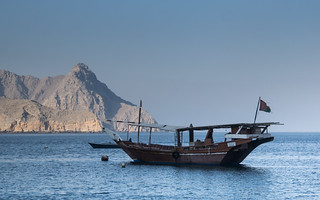
As a change from the doom, we finish with a relaximg view from Khasab, a historic town in Oman at the top of the Musandam Peninsula looking over the Strait of Hormuz. Wikipedia notes that “Iranians export sheep and goats into the local port, from where the animals are dispatched to the United Arab Emirates and Saudi Arabia in trucks.”
Let us all hope that one way or another peace is restored to that region very soon.
The Commercial
Institutions interested in updating their AI ethics policies or recasting their assessment policies to cope with the torrent of AI are encouraged to contact the author. The students are ahead of you.
so I asked ChatGPT to write the assignment of an unintelligent student
(LinkedIn)
 Opening up learning